 ToolScan
Odd Tools You’ve Never Seen (And What They’re Actually Used For)
Most home toolboxes are predictable: a claw hammer, a set of screwdrivers, a tape measure, a couple of adjustable wrenches, and a pair of slip-joint pliers. These universal tools handle 90% of everyday domestic repairs.
But step inside a master craftsman's workshop, an aircraft maintenance hanger, an antique glass studio, or an old agricultural barn, and you cross into an alternate universe of weird tools and their uses. You will find hand tools with hooked jaws, offset articulating cams, spring-loaded needle combs, and twin cutting disks that look more like medieval torture devices or science fiction props than functional workshop hardware.
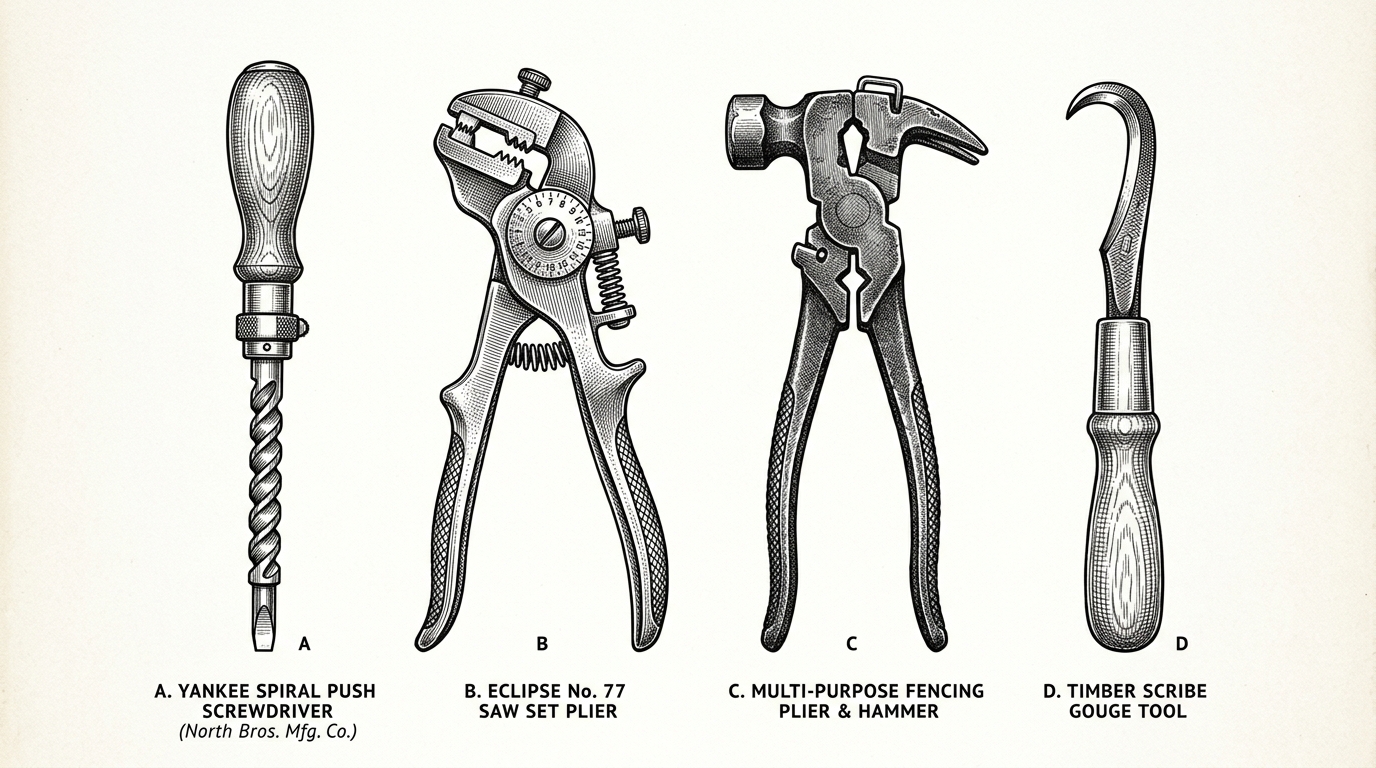
Why do these unusual hand tools exist? Because whenever a tradesperson faces a task that is repeated thousands of times—or an angle where standard wrenches cannot reach—human ingenuity invents a bespoke tool.
In this deep dive, we explore 8 of the strangest, most fascinating hand tools ever forged, reveal what they actually do, and explain how to recognize them when you stumble upon one in the wild.
8 Odd Tools You've Probably Never Seen (And Their Brilliant Uses)
1. The Basin Wrench (The Plumber’s Telescoping Claw)
What it looks like: A long, slender metal rod with a T-bar handle at one end and a spring-loaded, toothed jaw at the other that swivels 90 degrees or flips completely backward.
What it’s actually used for: Replacing kitchen or bathroom faucet nuts. Have you ever tried squeezing your shoulders underneath a bathroom vanity, peering up behind the deep ceramic sink bowl, trying to fit a standard crescent wrench onto a corroded brass locknut four inches from the wall? It is physically impossible. The basin wrench's pivoting head clamps vertically onto the nut while you twist the handle comfortably from below the basin rim. It is one of the single most frustrating tools to identify if you've never plumbed a sink, yet utterly indispensable when you need it.
2. Cleco Pliers and Fasteners (Aviation's Reusable Temporary Rivets)
What it looks like: A pair of heavy, plier-like squeeze handles accompanied by small color-coded cylindrical pins with tiny spring-loaded metal stems and prongs.
What it’s actually used for: Sheet metal fabrication and aircraft airframe assembly. When riveting together multiple curved sheets of aluminum on an airplane wing or racecar chassis, all rivet holes must remain in microscopic alignment. Cleco fasteners act as temporary spring-tensioned rivets. The Cleco pliers compress the spring to insert the pin into a drilled hole; releasing the pliers clamps the sheets together with up to 55 pounds of force. Once all panels are locked, permanent rivets are driven one by one.
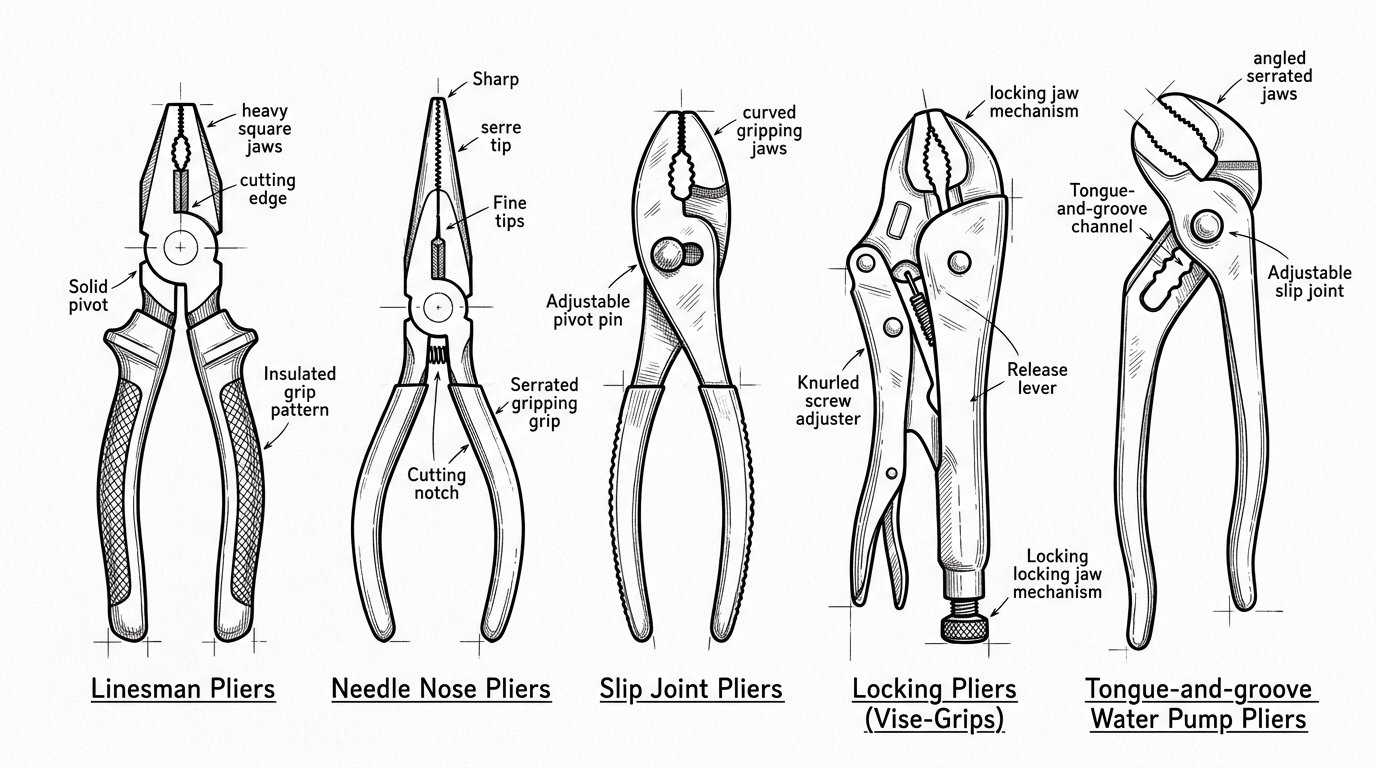
3. Fencing Pliers (The Rancher's Multi-Tool)
What it looks like: Heavy-duty forged pliers sporting a bizarre hammer head on one cheek, a pointed pick/spike on the other, multiple notch-style wire cutters in the throat, and curved gripping jaws on the nose.
What it’s actually used for: Agricultural wire fencing. A rancher repairing miles of barbed wire or woven field fence cannot carry a heavy toolbox across pastures. Fencing pliers do everything:
- The hammer face pounds staples into wooden fence posts.
- The hooked spike levers old, rusted staples out of rotted wood.
- The corrugated jaw grips splice and twist barbed wire strands under tension.
- The throat shear cut-outs snip high-tensile 12-gauge galvanized steel wire with maximum mechanical advantage.
4. Glass Running Pliers & Grozing Pliers
What it looks like: Pliers with wide, rubber-padded curved jaws featuring a central alignment tick mark, or narrow serrated jaws that taper inward.
What it’s actually used for: Stained glass artistry and glass glazing. Glass cannot be cut like wood or metal; it is scored with a carbide wheel to create a micro-fissure. Glass running pliers apply gentle, controlled, equal pressure on both sides of the score line from underneath while pressing down in the center. With a light squeeze, the glass snaps cleanly across the line like magic. Grozing pliers, meanwhile, are used to nibble away jagged rough glass edges.
5. The Contour Profile Gauge (The Needle Comb)
What it looks like: A flat frame housing hundreds of tightly packed, sliding plastic or metal pins arranged side by side like teeth on a giant ruler.
What it’s actually used for: Copying intricate irregular profiles onto flooring and tile. When fitting hardwood, laminate, or baseboard moldings around rounded door casings, stone hearths, or plumbing pipes, measuring angles with a ruler is a recipe for wasted material. Pressing the profile gauge against the uneven surface pushes the pins backward, creating a mirror-image silhouette that you can immediately trace with a pencil onto your workpiece.
6. The Scorp and Inshave (The Hollow Wood Carver)
What it looks like: A circular or U-shaped sharpened steel loop with one vertical handle (a scorp) or a curved slicing blade with two outward-flaring wooden handles (an inshave).
What it’s actually used for: Traditional Windsor chairmaking and wooden bowl carving. To hollow out the ergonomic saddle seat of a solid pine or oak chair, standard flat wood chisels or hand planes cannot cut along the concave curve. The inshave is drawn toward the woodworker's chest, taking thick ribbon shavings out of the hollow until the seat bottom matches the human body.
7. The Pin Spanner (Gland Nut Wrench)
What it looks like: A hinged or fixed hook with small cylindrical steel pegs protruding from the tips, resembling a skeletal metal crescent.
What it’s actually used for: Hydraulic cylinder repair, motorcycle suspension adjustment, and angle grinder discs. Round collar nuts (gland nuts) don't have hex sides that a normal socket or crescent wrench can grab; instead, they have tiny drilled holes along their perimeter or face. The pins of the spanner lock into these blind holes to transmit huge radial torque without deforming the circular casing.
8. The Cobbler’s Lasting Pliers
What it looks like: Pliers with wide, serrated duck-bill jaws, a prominent anvil-like hammer nub on one side of the pivot, and an angled prying hook at the base of one handle.
What it’s actually used for: Bespoke shoemaking. When stretching thick wet leather over a wooden shoe last (the foot-shaped mold), shoe cobblers need to pull the leather with tremendous grip, lever it over the curve of the sole using the pivot as a fulcrum, and immediately drive a small tack using the hammer nub without swapping tools.
Why Modern Toolboxes Lack These Oddities
If these tools are so effective, why doesn't Home Depot keep rows of scorps and bung wrenches on its front displays?
The evolution of manufacturing follows standardization:
- Fastener Standardization: In the 19th century, nearly every workshop designed its own proprietary screws, nuts, and barrel bungs. Today, ANSI, ISO, and DIN standards ensure that almost every machine uses standard metric or imperial hex hardware, Phillips, or Torx drives.
- Electric Power Tools: Specialized hand tools like molding planes and scorps were largely replaced by high-speed electric plunge routers, oscillating multi-tools, and angle grinders.
- Modular Building: Instead of hand-carving wooden fittings on-site, modern construction uses standardized drywall, PEX push-to-connect fittings, and pre-hung door packages.
What to Do When You Encounter an Unfamiliar Tool
When you come across an oddity at an estate sale, flea market, or in a dusty cardboard box left behind in your attic, you no longer have to spend hours browsing obscure collector forums or hoping Reddit users know their 19th-century blacksmithing implements.
Instead of guessing, use the smartphone in your pocket. ToolScan uses purpose-built computer vision trained specifically on millions of hand tools, vintage equipment, and trade-specific gear.
Ran into a tool that doesn’t look like anything in your toolbox? Let ToolScan scan it.
Point your camera at the tool, take a snapshot, and ToolScan instantly identifies:
- The exact official name of the tool
- The trade or industry it was engineered for
- How it is operated step-by-step
- Safety considerations and collectible value
Isuru writes practical guides on tool identification, safe usage, and maintenance, with a focus on AI-assisted learning.