 ToolScan
How to Identify Mystery Tools Found at Estate Sales and Garages
You are digging through a rusty metal bin under a workbench at a Saturday morning estate sale, or clearing out the dusty corner shelves of an inherited garage. Your hand closes around a heavy, blackened iron object. It possesses an articulated pivot, a strange curved jaw, perhaps a knurled brass thumbscrew, and zero modern branding. You turn it over in your hands, completely baffled: What on earth was this built to do?
You are not alone. Every weekend, thousands of DIYers, antique pickers, woodworkers, and homeowners encounter mystery tools. Many of these implements were engineered for trades that have changed drastically or vanished into industrial history—wheelwrights, coopers, carriage makers, farriers, cobblers, and early locomotive mechanics.
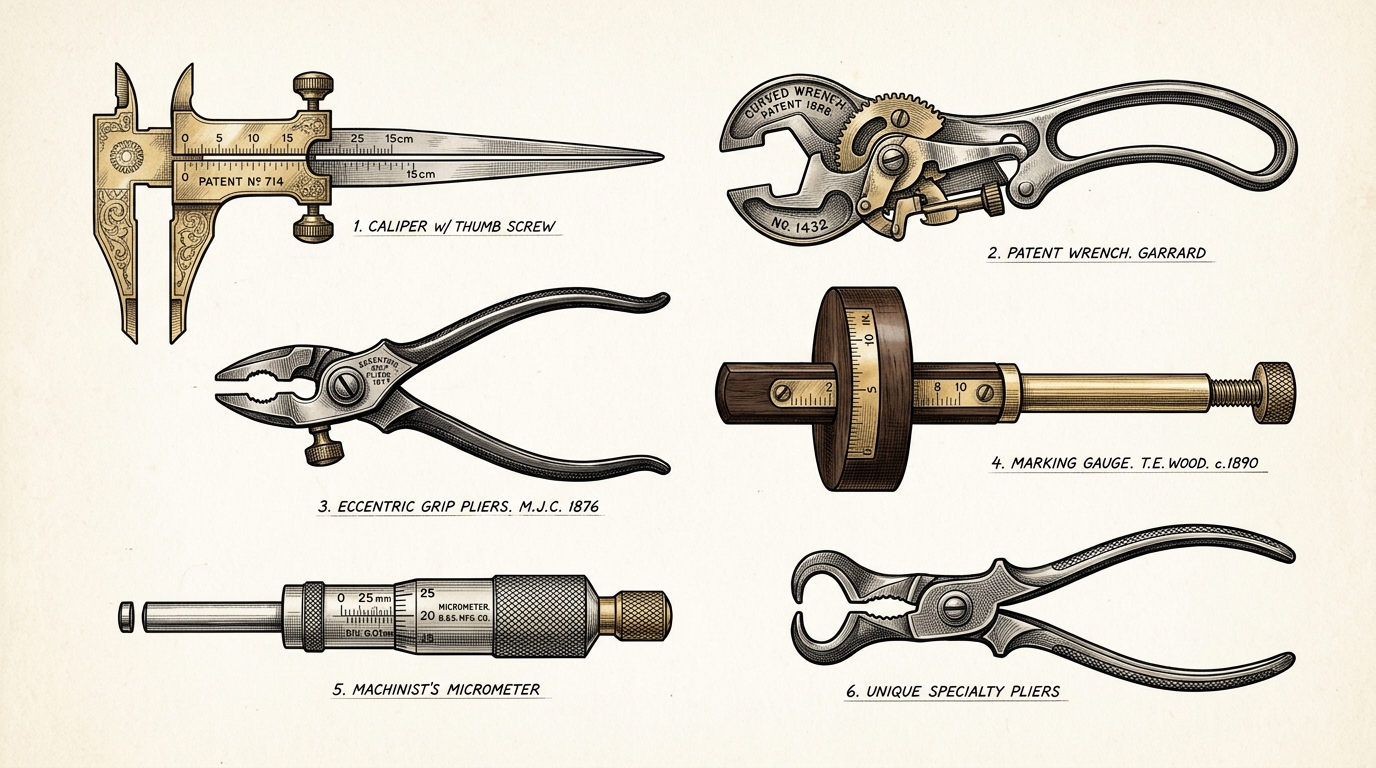
Not knowing what you have can mean passing on a rare collectible worth hundreds of dollars, or worse, misusing a fragile specialty tool and breaking it. In this guide, you will learn the exact step-by-step diagnostic system experts use to identify mystery tools found in garages and estate sales—and how modern AI visual scanners let you skip the hours of forum hunting.
The 6-Step Diagnostic Framework for Unknown Tools in Garages
When confronted with an unidentified object from an old workshop, don't rely on random guessing. Follow this structured forensic workflow:
1. Classify the Primary Mechanical Action
Every hand tool ever designed converts human mechanical energy into a specific action. Examine the tool's physical joints and working surfaces:
- Pivoting & Clamping: Does it feature two arms joined by a rivet, pin, or box joint? Check the jaws. Flat, smooth faces suggest sheet metal shaping or leatherwork; serrated opposing teeth point to pipe or wire manipulation; curved opposing hooks often belong to farrier clinchers or logging cant hooks.
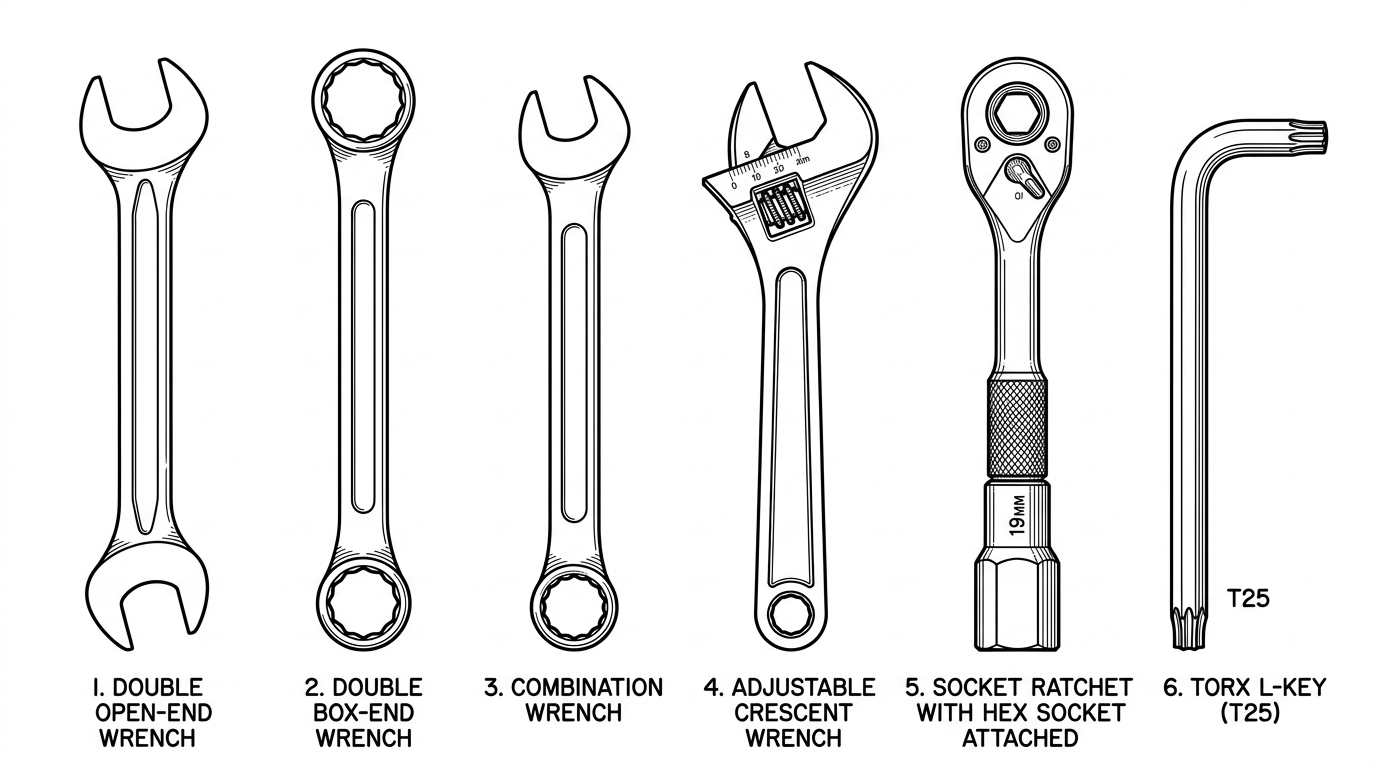
- Rotational Torque: Does it have an offset handle, socket profile, hex cutout, or opposing lugs? If the tool has a long lever arm terminating in pins or a singular notched claw, it was designed to apply rotational leverage to a collar or nut.
- Impact & Percussion: Does one end show signs of mushrooming, peening, or beveling? Tools struck with a mallet or hammer are constructed from heavy tool steel or wrought iron with tempered tips (chisels, punches, fullers).
- Cutting & Slicing: Look closely at the bevel. Single-bevel flat edges represent push tools (wood chisels, slicks); curved pulling blades with twin handles indicate drawknives, scorps, or inshaves for hollowing casks and chair bottoms.
- Material Gauging & Marking: Does it possess graduated tick marks, sliding rods, trammel points, or scribe needles? These are layout and drafting tools used by machinists, patternmakers, and joiners.
2. Search for Maker's Marks, Patent Dates, and Stampings
Before cleaning or polishing, inspect the metal under raking light (a flashlight held almost parallel to the surface). Look across these high-probability zones:
- The pivot boss or joint hub (standard for pliers, snips, and calipers)
- Along the shank or spine (common on wrenches, pry bars, and chisels)
- On the underside of wooden handles and brass ferrules
- Near adjustment threads or ratchets
Look for patent inscriptions such as "PAT'D JUNE 14 1898", "PAT. APPL'D FOR", or foreign stamps like "D.R.G.M." (German Reich utility patent) or "WD" with a broad arrow (British War Department). If you find a US patent date, you can search Google Patents directly with the year and month to uncover the inventor's original patent blueprint.
3. Analyze the Metallurgy and Construction
The material composition provides an immediate timeline for mystery garage tools:
- Hand-forged Wrought Iron (Pre-1880s): Look for subtle hammer facets, fibrous wood-like grain in oxidized areas, hand-peened rivets, and slight asymmetry.
- Malleable Cast Iron (1870s–1920s): Cast tools often have raised lettering, textured seam lines from sand casting molds, and decorative scrollwork.
- Drop-Forged Carbon Steel (1890s–1950s): Smooth body lines with crisp stamped lettering. Often stamped
"DROP FORGED"or"ALLOY STEEL". - Brass, Bronze, and Beryllium Copper: If a non-magnetic yellow or bronze alloy was used for the working head, the tool was engineered as a non-sparking safety tool for volatile environments (oil refineries, munitions factories, gas utilities) or marine navigational equipment.
- Wood Species on Totes and Handles: Antique American tools frequently used dense native woods: applewood or rosewood on hand planes and saws, hickory or ash on striking handles, and beech or boxwood on rules and mortise gauges.
4. Cross-Reference the Tool to Vanished Trades
Most baffling estate sale tools belonged to trades that modern DIYers never encounter. When an item makes no sense in a modern woodworking or auto garage context, ask yourself if it fits one of these specialty professions:
- Cooperage (Barrel Making): Coopers used bizarre drawknives, hoop drivers, chivs, and crozes to groove stave ends.
- Farrier & Blacksmithing: Tools with elongated handles designed for heat dissipation, hoof nippers, pritchels, and hardies that fit into anvil holes.
- Lead-Work Plumbing & Roofing: Before copper and PEX, plumbers shaped molten lead pipes using wooden turnpins, dresser sticks, and ladle irons.
- Leather & Shoemaking (Cobbler): Cobblers utilized curved lasting pliers with built-in mini hammers, edge irons, and welt trimmers.
- Logging & Forestry: Bark spuds (curved chisel-like blades for peeling bark), timber scribes, and cant hooks for rolling logs.
5. Clean Safely Without Destroying Clues or Value
When unearthing an unknown tool encrusted in heavy grime, grease, or rust, improper cleaning can erase valuable maker stamps and slash collector value:
- Do not wire-wheel or grind: Aggressive abrasive wheels round off stamped lettering and ruin original factory ground surfaces.
- Mineral spirits and brass brushes: Wipe down caked grease using odorless mineral spirits and a stiff nylon or soft brass wire brush. Brass is softer than steel and will not gouge the base metal.
- Chemical rust conversion (Evapo-Rust): Soak the metal in a pH-neutral chelating bath like Evapo-Rust for 4 to 12 hours. It selectively dissolves iron oxide while preserving base metal and residual patent stamps.
- Light paste wax: Once clean and dry, apply clear paste wax (such as Renaissance Wax or Johnson's) to preserve the historical patina.
6. Use ToolScan for Instant Visual AI Identification
Forum posts on r/Tools, r/whatisthisthing, or Garage Journal can take hours or days to garner a confident reply—and half the commenters will jokingly tell you it is a "flux capacitor."
If you are standing in a crowded garage sale with other pickers circling the tables, you don't have hours to wait for an internet forum.
ToolScan was built specifically to solve this dilemma:
- Open the app and snap a clear photo of the mystery tool.
- ToolScan's neural vision models evaluate the jaw configuration, pivot mechanics, maker contours, and wear patterns against millions of historical and contemporary tool profiles.
- Within seconds, the app displays the tool's exact name, historic trade, intended function, estimated vintage, and practical safety tips.
Snap a photo on ToolScan for immediate identification without searching forums.
5 Fascinating Mystery Tools Commonly Found in Old Garages
To train your eye, here are five unusual implements that regularly mystify people at estate sales:
1. The Saw Set (Saw Setting Pliers)
What it looks like: A pair of pistol-grip or plier-like handles with an adjustable knurled anvil disc, a micro-hammer plunger, and an angled viewing aperture.
What it actually does: Handsaw blades require their teeth to be bent slightly alternating outward (called "tooth set") so the saw blade's kerf is wider than the blade plate, preventing binding. This tool clamps down on each tooth and bends it precisely by degrees.
2. The Timber Scribe (Race Knife)
What it looks like: A folding knife or fixed wooden handle terminating in a tiny U-shaped gouge blade with an offset tracking spike.
What it actually does: Foresters, timber framers, and cargo inspectors used this tool to score Roman numerals or identification marks directly into green logs, structural beams, and wooden shipping crates.
3. The Alligator Wrench
What it looks like: A solid flat bar of steel with an open V-shaped mouth lined with aggressive, directional sawtooth ridges.
What it actually does: An early universal pipe and square-nut wrench widely used from 1890 to 1930. The harder you pulled the handle, the deeper the round pipe wedged into the tapering serrated V.
4. The Lead Dresser (Plumber's Bending Stick)
What it looks like: A paddle-shaped club carved from dense hornbeam, boxwood, or lignum vitae with a contoured handle.
What it actually does: Vintage plumbers and roofers used this non-marring wooden bat to beat sheet lead and lead pipes into shape around corners and chimney flashings without piercing the soft metal.
5. The Valve Spring Compressor (C-Clamp Style)
What it looks like: An exaggerated C-clamp with a screw on one end and a slotted, two-pronged fork on the opposing arm.
What it actually does: Mechanics used this tool to compress internal combustion engine overhead valve springs, locking them in place so the tiny split collet retainers could be extracted without sending the spring flying across the workshop.
Never Leave a Good Mystery Behind
Next time you spot a strange, grease-caked piece of iron poking out of an old wooden toolbox, don't write it off as scrap. Every vintage tool represents a clever solution to a difficult mechanical problem crafted by skilled tradespeople.
With a methodical eye, an understanding of historic trades, and ToolScan in your pocket, you can uncover the story behind every mystery tool within seconds.
Isuru writes practical guides on tool identification, safe usage, and maintenance, with a focus on AI-assisted learning.