 ToolScan
12 Types of Pliers and When to Use Each One
Open almost any toolbox in the world, and you will find at least one pair of pliers. But take a closer look at a professional mechanic's rolling cart, an electrician's pouch, or a jeweler's bench, and you will realize that "pliers" is not just one tool—it is an entire family of specialized hand tools, each meticulously engineered to grip, cut, twist, bend, or crimp materials under precise mechanical leverage.
Using the wrong pair of pliers can strip a fastener, slice right through delicate electrical conductors, mar finished chrome surfaces, or slip and give you badly bruised knuckles.
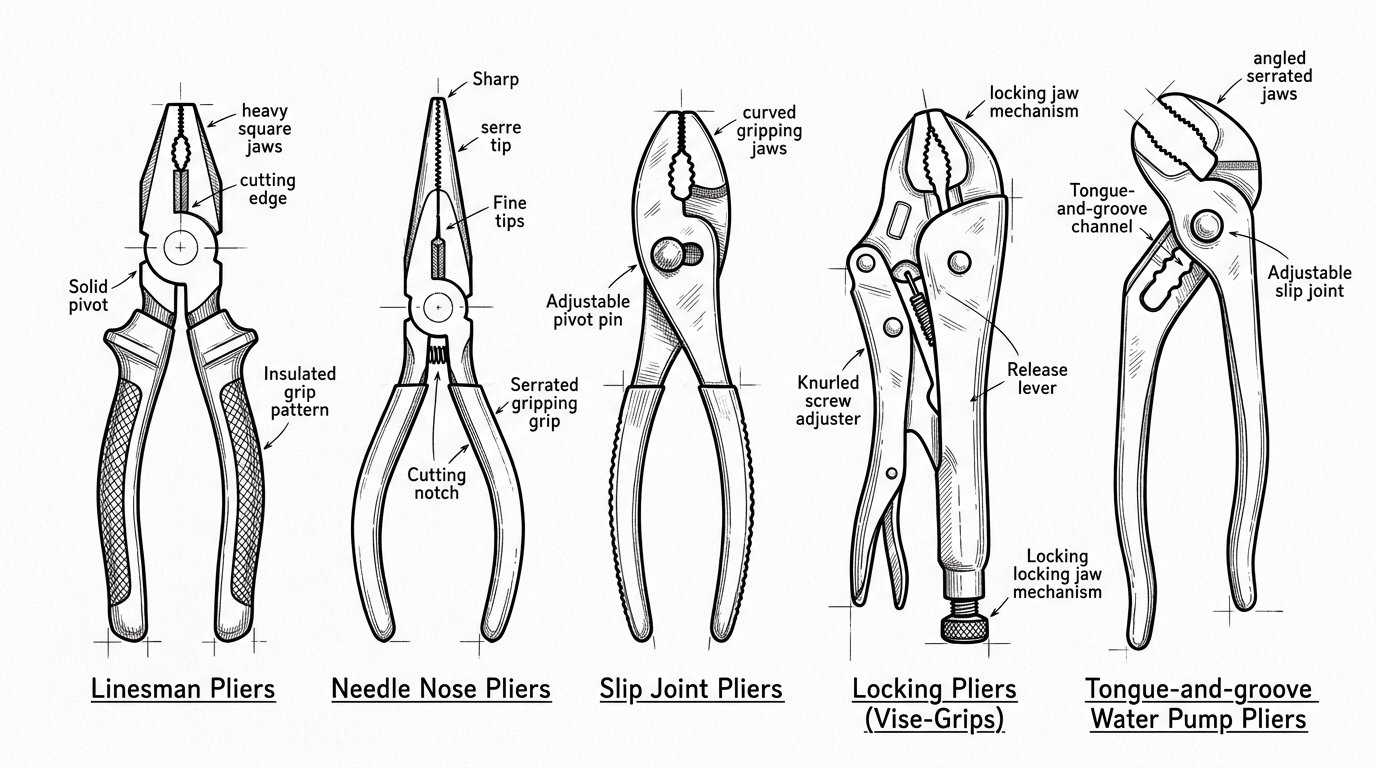
Whether you are trying to tell whether you're holding a pair of linesman or slip-joint pliers, or selecting the perfect tool for your next DIY project, this comprehensive plier identification guide breaks down the 12 essential types of pliers, their anatomy, and exactly when to use each one.
The Anatomy of Pliers: How Mechanical Leverage Works
Before comparing types, it helps to understand the anatomy of a pair of pliers. Every plier operates on the principle of a first-class lever:
- Jaws / Nose: The working surfaces that contact the workpiece. Jaws may be serrated (coarse or fine cross-hatch), completely smooth (non-marring), or formed with specialized semicircular cutouts.
- Cutters: Many pliers feature hardened bypass or anvil blades near the pivot point for shearing copper wire, nails, or zip ties.
- Pivot Point (Fulcrum): The rivet, bolt, or box-joint that connects the two halves. The closer the pivot point is to the jaws relative to the handles, the higher the mechanical advantage (clamping force).
- Handles: The leverage arms. Modern pliers usually feature dipped PVC, molded ergonomic dual-component grips, or high-dielectric insulated rubber rated for 1,000 volts.
12 Types of Pliers and When to Use Each One
1. Slip-Joint Pliers (The Household Universal)
Distinctive Feature: A figure-eight or two-position slotted pivot hole that allows the fulcrum to slide between two positions.
Jaw Profile: Curved, serrated belly with flat gripping tips and a small shear wire cutter near the pivot.
Best Used For: General household utility work, gripping rounded rods, pulling stubborn cotter pins, and holding miscellaneous items securely while you work.
When NOT to Use: Do not use slip-joint pliers to turn hexagonal nuts and bolts. The serrated jaws will chew up the bolt corners, leaving them stripped and rounded.
2. Linesman Pliers (Kleins / Electrician's Pliers)
Distinctive Feature: Heavy, broad, square-nosed head with exceptional mass and high-leverage pivot placement.
Jaw Profile: Cross-hatched flat jaws for twisting multiple heavy-gauge conductors together, backed by induction-hardened side cutting blades capable of chopping Romex cable and steel nails.
Best Used For: Electrical rough-in work, pulling fish tape through metal conduit, and twisting solid electrical wires before wire-nut installation.
3. Tongue-and-Groove Pliers (Water Pump / Channellocks)
Distinctive Feature: An adjustable curved pivot track with interlocking undercut tongue-and-groove ribs that allow the jaws to open wide while remaining parallel.
Jaw Profile: Heavily serrated, angled jaws designed to wrap securely around round pipes, large conduit fittings, and plumbing union nuts.
Best Used For: Plumbing installations, gripping sink trap nuts, tightening garden hose connectors, and holding odd-shaped metal pieces.
Pro Tip: Always pull tongue-and-groove pliers toward the lower handle so the force locks the upper jaw down onto the workpiece without slipping.
4. Needle-Nose Pliers (Long-Nose Pliers)
Distinctive Feature: Elongated, slender jaws that taper to a fine point.
Jaw Profile: Fine cross-cut serrations along the tip for precision gripping, often with a small wire cutter near the throat.
Best Used For: Reaching into cramped electrical junction boxes, bending small wire loops around screw terminals, holding tiny fasteners in place, and manipulating jewelry or electronics.
When NOT to Use: Never use needle-nose pliers for heavy twisting or breaking stuck bolts loose. The thin tips will twist out of alignment and permanently deform.
5. Locking Pliers (Vise-Grips)
Distinctive Feature: An over-center mechanical toggle mechanism with an adjustable screw at the bottom of the handle and a release trigger.
Jaw Profile: Available in curved (pipe), straight (hex/flat stock), and long-nose profiles with hardened serrations.
Best Used For: Clamping objects hands-free with immense pressure, holding two sheets of metal during welding, extracting rounded-off or sheared bolts, and acting as a temporary emergency clamp.
6. Diagonal Cutting Pliers (Dikes / Side Cutters)
Distinctive Feature: Jaws that consist solely of angled cutting blades with no flat gripping surface.
Jaw Profile: Hardened wedge-shaped cutting edges ground at an angle to allow flush or semi-flush cuts against flat surfaces.
Best Used For: Snapping electrical wire, trimming plastic zip ties cleanly without leaving razor-sharp burrs, pulling staples, and cutting small nails and screws.
7. End-Cutting Pliers (Nippers / Carpenter's Pliers)
Distinctive Feature: A broad, rounded nose with cutting blades positioned perpendicular to the handles at the very front tip.
Jaw Profile: Razor-sharp opposing blades that meet flush at the forehead of the tool.
Best Used For: Trimming tie wire during concrete rebar reinforcement, pulling headless finish nails through the backside of baseboard trim without marring the face, and flush-cutting soft wire.
8. Snap Ring Pliers (Circlip / Retaining Ring Pliers)
Distinctive Feature: Cylindrical pin tips instead of jaws, often equipped with a reversible pivot switch or interchangeable tip angles (0°, 45°, 90°).
Jaw Profile: Two tiny, hardened steel prongs designed to insert into the pinholes of spring-steel snap rings.
Best Used For: Removing and installing internal and external retaining rings inside automotive transmissions, motorcycle forks, wheel bearings, and lawnmower gearboxes.
9. Wire Stripping Pliers & Crimpers
Distinctive Feature: Laser-etched sizing notches corresponding to American Wire Gauge (AWG) standards (e.g., 10, 12, 14, 16, 18 AWG).
Jaw Profile: Precision-ground circular blades that slice cleanly through insulation without nicking the copper core, combined with front gripping teeth and a color-coded insulated/non-insulated terminal crimper.
Best Used For: Clean electrical wiring, prepping outlets, and crimping automotive spade or bullet connectors.
10. Bent-Nose Pliers
Distinctive Feature: Long, tapered needle-nose jaws bent at an angle (usually 45° or 90°) relative to the handle shaft.
Jaw Profile: Fine serrations with a slim profile.
Best Used For: Reaching around obstructions inside crowded computer cases, automotive dashboards, or carburetors where a straight pair of pliers would block your line of sight.
11. Flat-Nose Pliers (Duckbill Pliers)
Distinctive Feature: Broad, perfectly flat, rectangular jaws without a taper.
Jaw Profile: Smooth, toothless interior faces that prevent marring metal finishes.
Best Used For: Bending clean right angles in sheet metal, manipulating delicate jump rings and clasps in jewelry, and safety-wiring aviation aircraft fasteners.
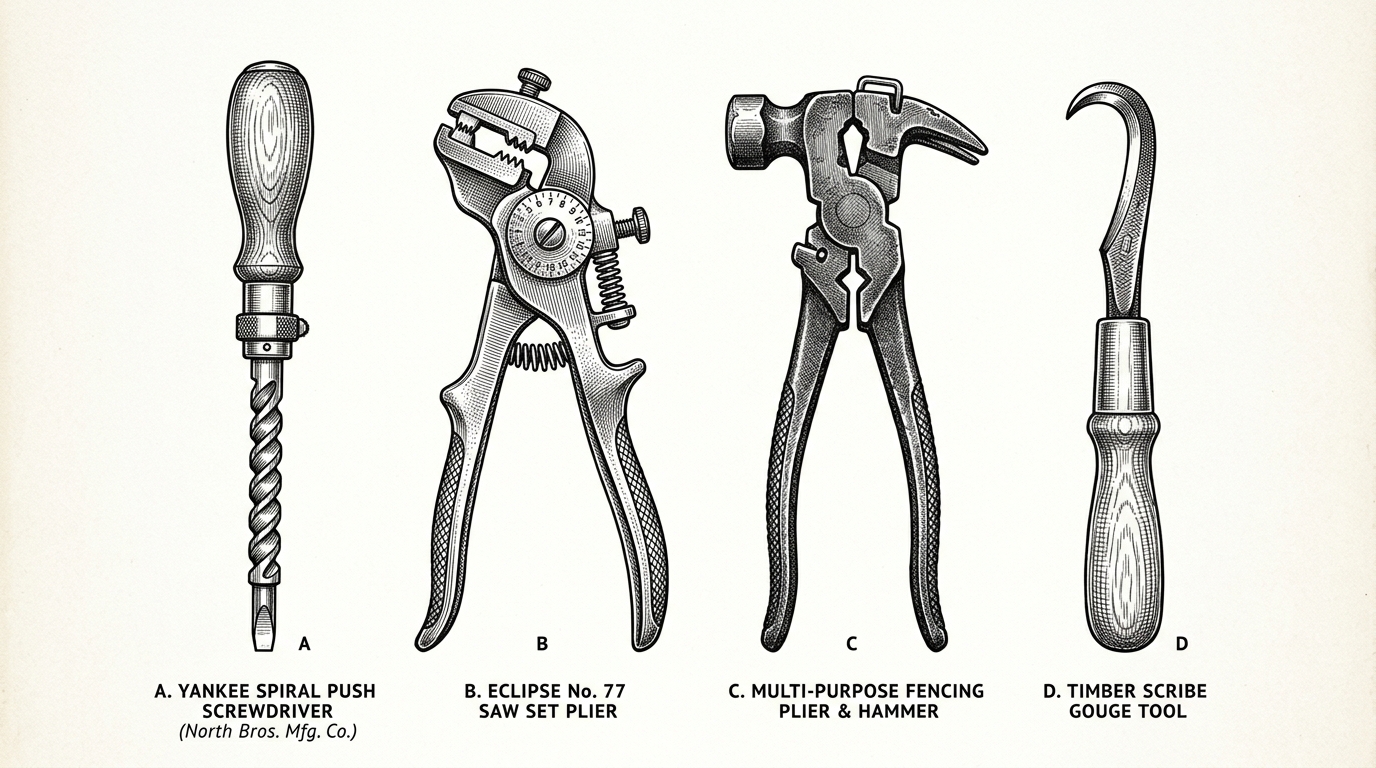
12. Fencing Pliers
Distinctive Feature: A heavy forged head incorporating an integral hammer head, a pointed staple-pulling pick, and dual wire-shearing notches.
Jaw Profile: Corrugated gripping nose designed to grab and twist heavy-gauge galvanized fence wire.
Best Used For: Installing, tensioning, repairing, and stapling agricultural barbed wire or field fencing.
How to Identify Mystery Pliers Instantly with ToolScan
If you have inherited a toolbox or picked up an unusual tool at an estate sale and can't tell whether you're holding a pair of water pump pliers, retaining ring pliers, or specialty cobbler's lasting pliers, don't waste hours scrolling through hardware catalogs.
Not sure if you’re holding linesman, slip-joint, or tongue-and-groove pliers? Scan to verify.
With ToolScan, identifying any pair of pliers takes seconds:
- Open the ToolScan app on your phone.
- Snap a photo of the pliers lying on a flat surface.
- ToolScan’s neural computer vision engine analyzes the jaw profile, pivot joint geometry, and handle configuration to identify the tool, explain its original trade purpose, and suggest best practices for safe use.
Isuru writes practical guides on tool identification, safe usage, and maintenance, with a focus on AI-assisted learning.