 ToolScan
The Complete Guide to Wrench Types: Sockets, Open-End, Torx, and Beyond
Few sounds in the workshop are more sickening than the dull metallic snap of a rounded bolt head. It usually happens when you are rushed, working in a tight spot, and using the wrong wrench—or the wrong size—on a stubborn fastener.
The humble wrench (or spanner) is one of humanity’s oldest and most essential mechanical inventions. Its job is straightforward: transmit rotational force (torque) to tighten or loosen a threaded fastener. But because machines, engines, plumbing fixtures, and electronics operate in wildly different spaces under vastly different torque requirements, engineers have devised dozens of distinct wrench configurations.
Whether you are assembling your first automotive toolkit or trying to decipher the difference between SAE, Metric, Torx, and Whitworth fasteners, this types of wrenches guide covers every essential wrench profile, how they work, and how to master wrench sizes and types.
The Physics of Fastener Grip: Why Bolt Rounding Happens
To choose the right wrench, you must understand how torque transfers into a fastener head:
- Corner Contact vs. Flank Drive: Cheap or poorly fitting wrenches make contact solely on the sharp corners of a hexagonal bolt head. When high torque is applied, the wrench acts like a chisel, shearing the soft corners off and creating a smooth, un-turnable circle. Premium wrenches and sockets utilize "flank drive" or "off-corner engagement" geometry, where the wrench contacts the flat side of the bolt hex several millimeters away from the corner.
- Enclosed vs. Open-Ended: An open-ended wrench contacts only two parallel flats of a 6-sided hex head. Under heavy torque, the steel jaws of an open wrench naturally flex outward, allowing the tool to slip. A box-end or socket encloses all six corners, completely eliminating jaw spread.
The Essential Types of Wrenches and When to Use Them
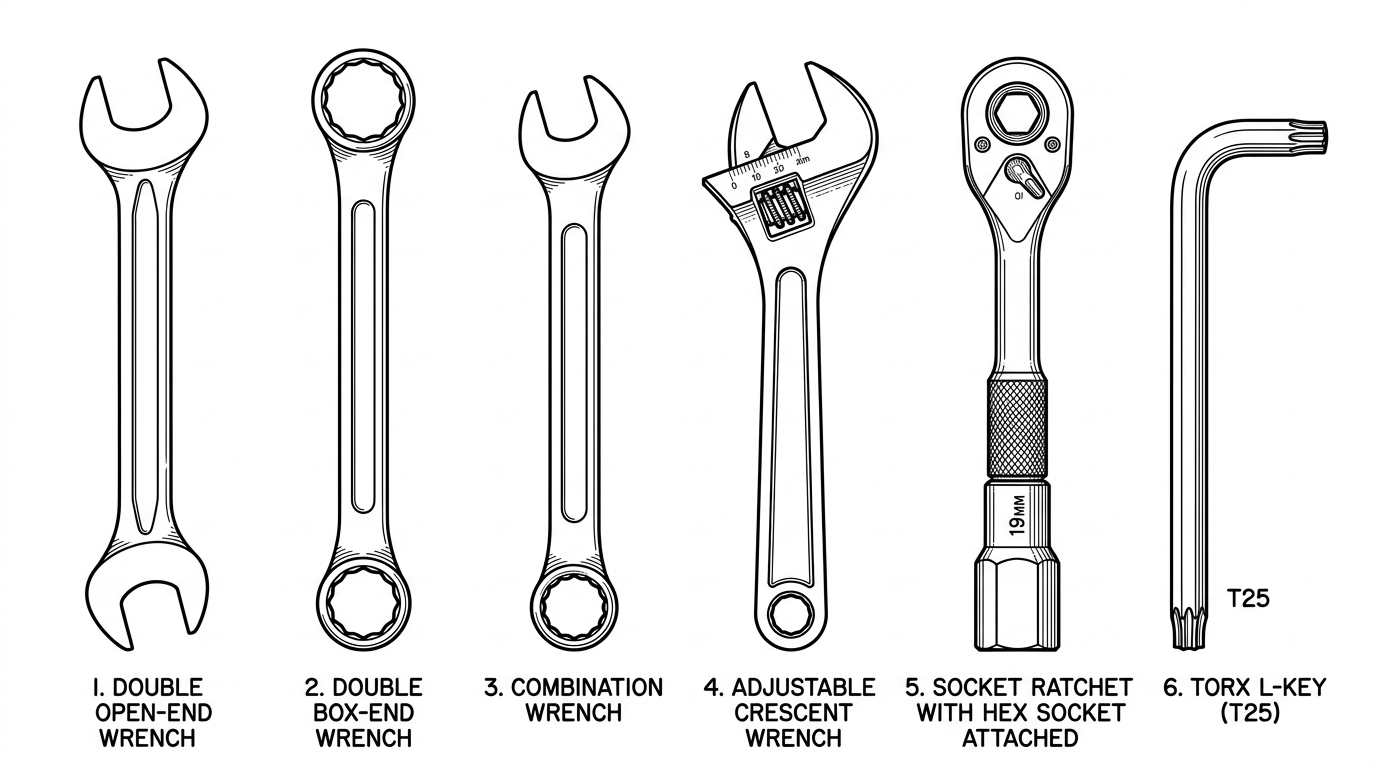
1. Open-End Wrenches
Design: A U-shaped opening with two parallel flat gripping faces. The head is typically angled at 15 degrees relative to the longitudinal handle axis.
Why the 15° Angle Matters: In tight engine compartments where you only have 30 degrees of handle swing, turning the bolt, flipping the wrench over, and re-engaging the flats allows you to continuously turn a bolt in confined spaces where a straight wrench would get stuck against an obstruction.
Best Used For: Rapidly running nuts down long threaded rods or sliding onto bolt heads where overhead clearance is blocked.
2. Box-End Wrenches
Design: A continuous enclosed ring containing an internal 6-point (hexagonal) or 12-point (bi-hexagonal) broached profile.
6-Point vs. 12-Point:
- 6-Point: Provides maximum surface contact along fastener flats. Essential for breaking loose frozen, rusted, or high-torque bolts without slipping.
- 12-Point: Allows engagement every 30 degrees of rotation (versus 60 degrees for a 6-point head), making it twice as fast to align in tight quarters, but carries a higher risk of rounding soft fasteners under extreme load.
Best Used For: Applying high breaking torque to stuck nuts.
3. Combination Wrenches
Design: The quintessential mechanic's hand tool. Features an open-end jaw on one end and a box-end ring of the exact same size on the other.
Best Used For: The complete tightening cycle. Use the box end to break the fastener loose with maximum torque; flip the wrench to the open end to quickly spin the fastener off.
4. Ratcheting Wrenches
Design: Similar in appearance to a standard combination wrench, but the box end houses a compact, fine-tooth ratcheting gear mechanism (typically 72 to 120 teeth).
Key Advantage: A 72-tooth ratchet requires only a 5-degree swing arc to click and reset, allowing you to tighten bolts in cramped spaces without ever lifting the tool off the fastener head.
Best Used For: Automotive engine repairs, brake caliper mounting bolts, and assembling machinery in confined quarters.
Caution: Do not use ratcheting box ends to break loose rusted, seized bolts using hammer strikes—the internal pawls and micro-springs can fracture.
5. Adjustable Wrenches (Crescent Wrenches)
Design: An open-end wrench featuring one fixed jaw and one movable jaw adjusted via a knurled worm gear (screw mechanism).
The Proper Direction Rule: An adjustable wrench must always be pulled toward the movable jaw, so that the rotational load is supported by the rigid, fixed spine of the tool body. Pushing away from the movable jaw forces the worm gear to bear the entire load, stretching the jaw open and rounding the bolt.
Best Used For: Plumbing fittings, assembling flat-pack equipment, and emergency situations where you don't have a complete wrench set on hand.
6. Socket Wrenches & Ratchets
Design: A ratcheting drive handle connected to interchangeable cylindrical socket cups via a spring-loaded square drive tang.
Standard Drive Sizes:
- 1/4-inch Drive: Precision work, electronics, small engines, interior dashboard trim (typically 4mm to 14mm / 5/32" to 9/16").
- 3/8-inch Drive: The most versatile all-around automotive size; handles suspension, spark plugs, and chassis components (typically 8mm to 19mm / 5/16" to 7/8").
- 1/2-inch Drive: Heavy equipment, wheel lug nuts, truck suspension, and high-torque engine head bolts (typically 13mm to 36mm / 1/2" to 1-1/2").
Chrome vs. Impact Sockets: Never use shiny chrome sockets on pneumatic or cordless impact wrenches. Chrome sockets are hardened to be rigid but brittle, and will shatter under impact hammering. Impact sockets are made of ductile chrome-molybdenum steel with thicker walls and a black phosphate finish to absorb repetitive shock.
7. Torque Wrenches
Design: A specialized ratchet calibrated to measure the exact amount of rotational tension applied to a fastener, preventing over-tightening or under-tightening.
Varieties: Click-type, digital electronic, and beam-type deflection scales.
Best Used For: Critical safety assemblies including cylinder head studs, spark plugs, brake rotors, and wheel lug nuts.
8. Hex Keys (Allen Wrenches) & Torx Keys (Star Keys)
Design: L-shaped solid metal hexagonal or 6-point star rods, as well as socket-driven bit inserts.
- Hex (Allen): Six flat sides fitting into recessed internal socket head cap screws. Common on bicycles and modern machinery.
- Torx (Star Drive): A 6-point star profile designed to prevent cam-out. Torx fasteners (designated T10, T15, T20, T25, T30, T40, etc.) transfer significantly more torque with zero slip.
- Specialty Profiles: Security Torx with center pins, Torx Plus, and 12-point Triple Square (XZN) common on German automotive drivetrains.
9. Pipe Wrenches (Stillson Wrenches)
Design: A heavy cast-iron or aluminum tool featuring a spring-loaded floating hook jaw and a fixed heel jaw lined with directional sawtooth ridges.
Mechanical Function: Designed strictly for threaded iron, black gas, and galvanized steel pipe. The floating hook jaw rocks slightly in its collar; as you pull the handle, the teeth bite into the soft round metal pipe, gripping tighter as torque increases.
10. Flare Nut Wrenches (Line Wrenches)
Design: Resembles a thick box-end wrench with a narrow opening cut into the ring just wide enough to slide over hydraulic metal tubing.
Best Used For: Brake lines, hydraulic clutch fittings, and air conditioning refrigeration lines. Soft brass and aluminum flare nuts strip instantly if an open-end wrench is used. A flare nut wrench grips five of the six hex flats, distributing torque evenly.
Wrench Sizing Systems Decoded: Metric vs. SAE
One of the most confusing hurdles for any DIYer is matching the wrench to the fastener sizing system:
- Metric (SI): Measured in millimeters across flats (e.g., 8mm, 10mm, 13mm, 17mm, 19mm). Used on all modern European, Japanese, Korean, and domestic cars built after 1990; bicycles; and global appliances.
- SAE (Imperial): Measured in fractional inches (e.g., 1/4", 3/8", 1/2", 9/16", 3/4"). Used on classic American cars, aviation, domestic plumbing, and lawnmowers.
Never Guess a Bolt Size Again: How to Identify Wrenches with ToolScan
Staring at a bolt head recessed deep inside your engine bay or under your car's suspension? Grabbing socket after socket from your drawer hoping one "feels snug" is how fasteners get rounded and projects get delayed.
Check size compatibility and bolt types using ToolScan.
ToolScan eliminates the guesswork:
- Aim your phone camera at the bolt or unknown wrench head.
- ToolScan instantly identifies the fastener drive standard (Hex, Torx, Triple Square, Robertson, E-Torx).
- The app determines the exact matching socket or wrench size (Metric or SAE) and warns you about potential cross-fit traps (such as mistakenly using a 1/2-inch wrench on a 13mm bolt).
Isuru writes practical guides on tool identification, safe usage, and maintenance, with a focus on AI-assisted learning.